n8n vs Custom Automation: Which One Is Better for Your Business?
A practical comparison of n8n and custom automation for businesses that need reliable workflows, integrations, and reporting.
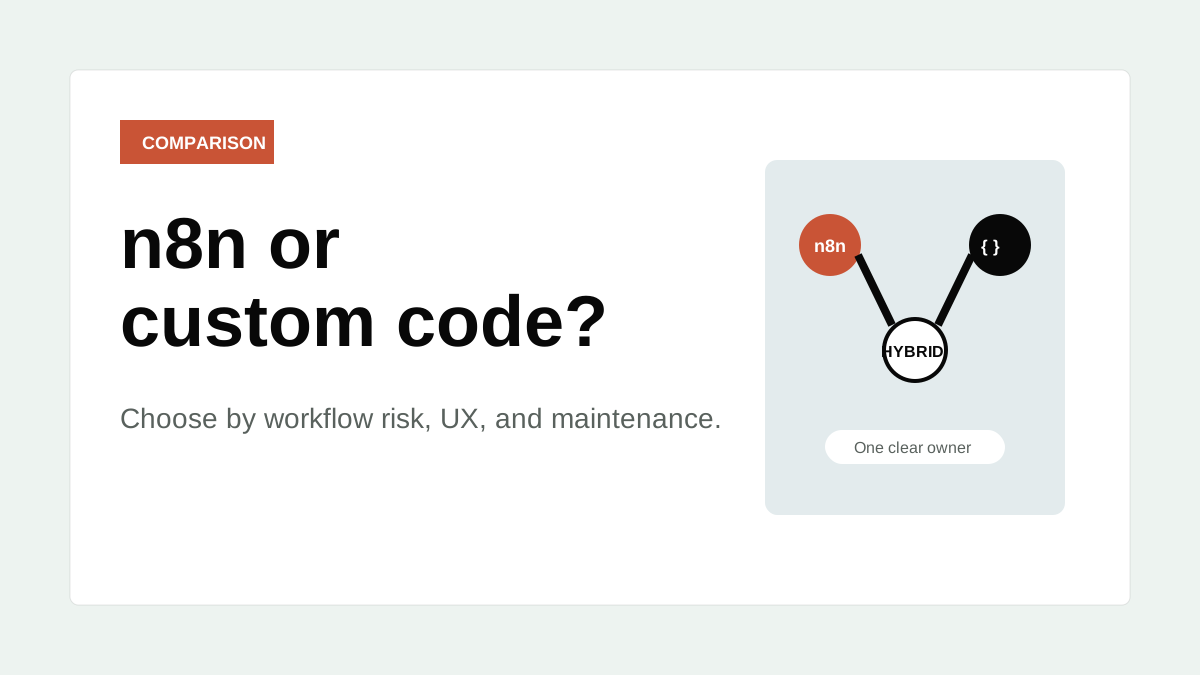
If your workflow is mostly move data, call an API, notify a person, n8n is usually the quickest sensible start. If the workflow is a product your customers or team use every day, with complex permissions, high volume or strict reliability requirements, custom code is usually the safer foundation. Many useful systems combine both.
The decision in one table
| Question | n8n is usually stronger | Custom code is usually stronger |
|---|---|---|
| First usable version | Days for a focused workflow | Weeks for a production application |
| Integrations | Standard SaaS tools with existing nodes | Proprietary APIs or unusual protocols |
| Business rules | Linear steps and visible branches | Dense rules, permissions and state |
| Interface | Internal workflow canvas | Customer-facing or role-based product UI |
| Operations | Small team, moderate volume | High volume, strict monitoring and recovery |
| Maintenance | A trained operator can inspect runs | A developer owns tests, releases and observability |
Choose n8n when speed and visibility matter most
n8n fits lead routing, CRM updates, document alerts, scheduled reports and simple AI-assisted classification. A business operator can inspect the workflow, see where a run failed and change a mapping without rebuilding an application.
That speed has limits. A large canvas with many branches can become harder to reason about than code. Before launch, define retry rules, duplicate protection, credentials, logs and what happens when one connected service is unavailable.
Choose custom code when the workflow is the product
Custom Laravel, Node.js or Next.js code is a better fit when users need accounts, permissions, an audit trail, complex pricing or a dedicated interface. It also gives the team direct control over automated tests, versioned releases, data models and performance.
Custom does not mean rebuilding every integration. The application can keep critical business rules in code and call n8n for secondary tasks such as notifications, enrichment or scheduled exports.
A practical hybrid architecture
A common production setup is:
- The application and database hold customers, permissions, orders and workflow status.
- n8n receives a narrow event, such as “qualified lead created”.
- n8n updates an approved CRM, sends an internal notification and records the result.
- Failed or uncertain runs return to an operator instead of silently continuing.
This keeps the core business state in a system you control while preserving n8n's speed for integrations.
What changes the real cost
The licence or hosting bill is only one part of the decision. Compare the time required to build, test and monitor the workflow; the cost of failed runs; how often integrations change; and who can maintain it six months later. A cheap workflow that duplicates customer records or misses requests is expensive in practice.
Four questions I use before recommending a stack
- Does the workflow change money, access or a customer promise?
- Must a person approve an action before it is sent?
- Can the same event arrive twice, and is the workflow safe if it does?
- Will the business need a dedicated dashboard or customer-facing interface?
If the first version has one clear trigger and a handful of standard integrations, start with n8n and measure it. If reliability, permissions and product UX are already central, build the core in custom code. For a real workflow, I map the trigger, data owner, failure paths and human approval points before choosing either option.
Related work
See AI automation in Morocco, business dashboard development, and the public CRM × WhatsApp workflow. The CRM example is explicitly illustrative; it shows the intended process without claiming client results.
FAQ
Is n8n suitable for a production business workflow?
Yes, when the workflow is narrow, monitored and designed for retries and duplicates. Critical records should still have a clear system of record.
Can an n8n workflow be replaced later?
Yes, if data contracts and business rules are kept clear. A tightly coupled canvas with hidden state is harder to replace than small workflows with explicit inputs and outputs.
Do I need AI in the workflow?
Only when a step benefits from language understanding, classification or drafting. Deterministic rules should remain deterministic, and important customer or financial decisions should keep human approval.
Want more like this?
Get the free toolkit + occasional tips on React Native, Next.js, and AI.
No spam. Unsubscribe anytime.
Related services & guides