Freelancer vs Agency in Morocco: Who Should Build Your Website?
A practical comparison for Moroccan businesses choosing between a freelance developer and an agency for websites, apps, dashboards, and automation.

Hamza El Haissouf
6 min readUpdated EN

Key takeaways
- A freelancer fits a focused project with one decision-maker and a clear scope. An agency fits a large, multi-discipline project that needs several people at once.
- Ask who will actually do the work, who you will talk to every week, and who owns the code, accounts and domain at the end.
- Judge any candidate on shipped, public work and on how they handle scope, not on a portfolio of mockups.
- Plan for after launch from the first conversation: hosting, updates, small changes and who answers when something breaks.
Short answer
Choose a freelancer when the project is focused, you want to speak directly with the person who builds it, and speed and flexibility matter more than a large team. Choose an agency when you need design, development, content and marketing in parallel, with formal project management. In both cases, the deciding factors are shipped work you can check, clear ownership of what is built, and a written plan for support after launch.
Choosing who builds your website, app or automation is one of the decisions that shapes everything after it: how fast you launch, how easy it is to change things later, and how much of your own time the project takes. In Morocco the choice usually comes down to two options, a freelance developer or an agency. Both can do excellent work. Both can also go wrong in predictable ways.
This guide walks through how each option works in practice, which projects suit each, the questions that reveal quality, and the warning signs to watch for. It is written for business owners and managers who are about to hire and want to choose with their eyes open.
What is the real difference between a freelancer and an agency?
The difference is not talent; it is structure.
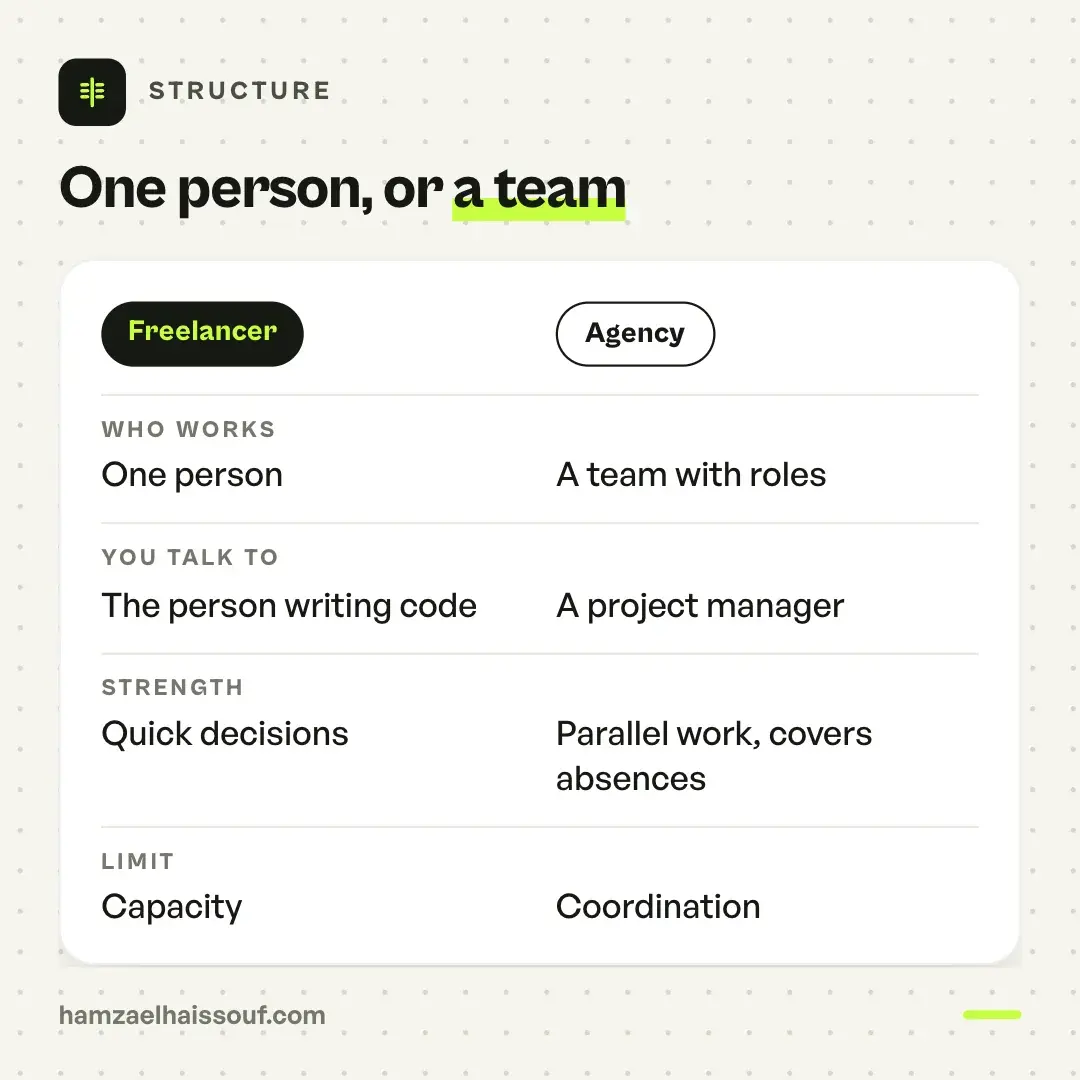
A freelancer is one person who sells and delivers the work. You talk directly to the person writing the code. Decisions are quick, and the context does not get lost between people. The limit is capacity: one person can only do so much at once.
An agency is a team with roles: a salesperson or account manager, a project manager, designers, developers, sometimes content and marketing. It can run several workstreams in parallel and absorb absences. The cost is coordination: your message passes through people before it reaches whoever does the work.
Neither is better in general. The right choice depends on the size and shape of your project.
Which option fits which project?
| Situation | Freelancer is usually stronger | Agency is usually stronger |
|---|---|---|
| Scope | Focused: one site, one app, one workflow | Broad: brand, site, content and campaigns together |
| Decision-making | One decision-maker on your side | Several departments to align |
| Speed to first version | Fast, few handoffs | Depends on the agency's schedule |
| Communication | Direct with the builder | Through an account or project manager |
| Continuity | Depends on one person | Team can cover absences |
| Specialised skills | Deep in one area | Several disciplines in-house |
A clinic website with WhatsApp booking, a logistics quote form connected to a CRM, or a first version of an internal tool are typical freelancer projects. A national retail brand relaunching its identity, website and campaigns at the same time is typical agency work.
How do you check that someone can actually deliver?
Portfolios are easy to dress up. Look for evidence that is hard to fake:
- Live, public work. Open the sites and apps. Check them on your phone. Are they fast? Do the forms and WhatsApp buttons work?
- Case studies that explain decisions. A good case study says what the problem was, what was built and why, not only how it looks.
- Code or technical writing. A public repository or technical articles show how someone thinks.
- References you can contact. Ask for one or two past clients, and actually call them.
Then ask the candidate to explain one past project in detail: what went wrong, and what they did about it. People who have shipped real work have clear, specific answers.
Which questions should you ask before hiring?
Use these in the first call. The answers tell you more than any presentation.
- Who exactly will do the work, and who will I talk to every week?
- What do you need from me, and when? (Content, photos, access, decisions.)
- How do you handle changes that come up in the middle of the project?
- Where will the code live, and who owns the domain, hosting and accounts?
- What happens after launch? Who fixes bugs, applies updates and makes small changes?
- How will we know the project worked? Which measures will we look at?
- Can you show me something similar you built, live?
Write down the answers. Comparing candidates on the same seven questions is fairer than comparing two very different proposals.
What are the warning signs?
Some patterns predict trouble regardless of who you hire:
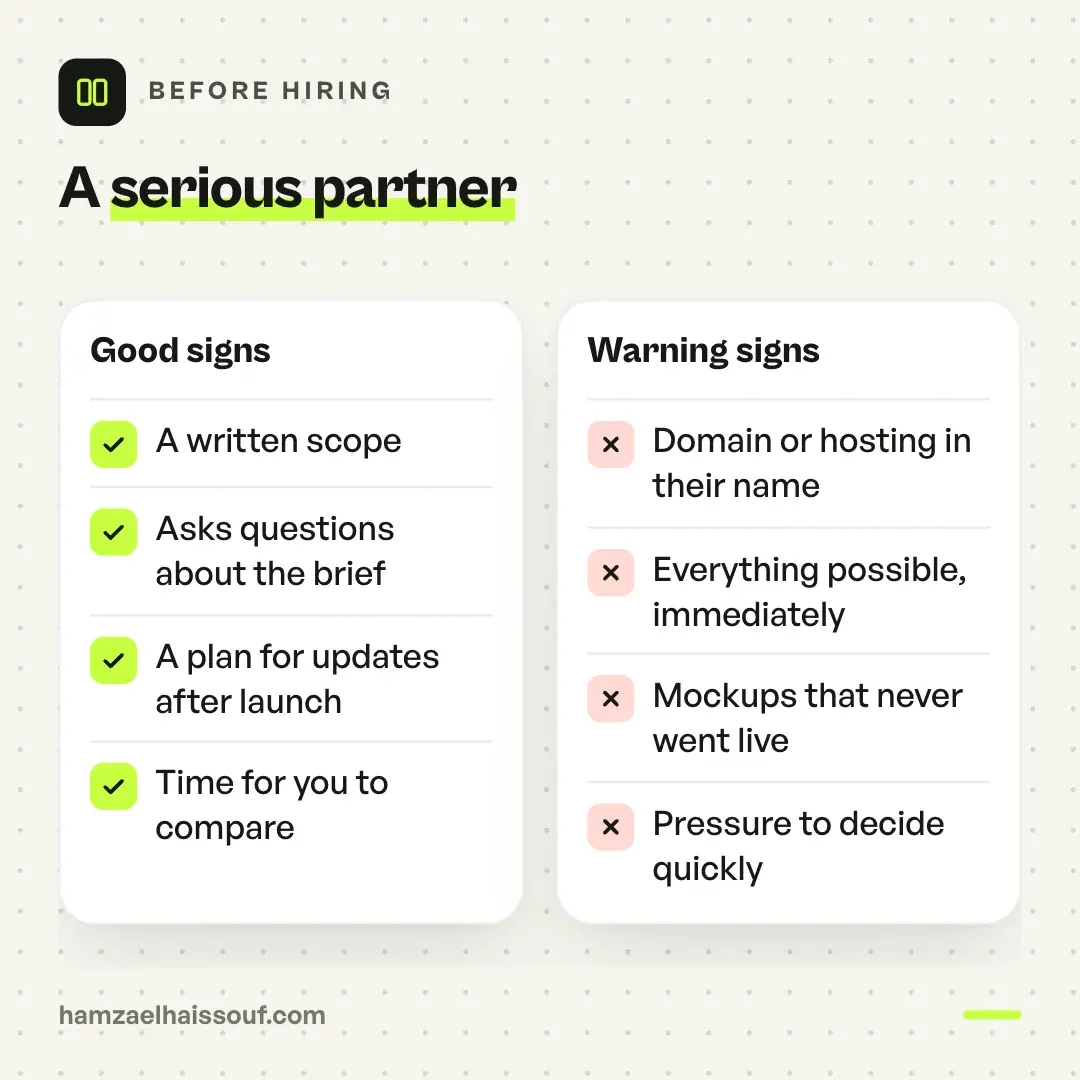
- No written scope. If it is not written, every disagreement becomes a negotiation.
- Vague ownership. The domain or hosting registered in the developer's name, or code you cannot access.
- Everything is possible, immediately. Good builders ask questions and push back on parts of the brief.
- A portfolio of mockups only. Designs that never went live tell you little about delivery.
- No plan after launch. Websites and apps need updates. Silence on this topic means you will be alone with it later.
- Pressure to decide quickly. A serious partner gives you time to compare.
How should the work be scoped and contracted?
Whatever you choose, ask for a short written scope that covers:
- The pages, screens or features included, and what is explicitly excluded.
- Who provides content and when.
- Integrations: WhatsApp, booking tools, CRM, payment, analytics.
- Languages, and who translates.
- Launch tasks: domain, hosting, analytics, search console, redirects from an old site.
- Support after launch: what is included, for how long, and how extra requests are handled.
Split the project into stages with a review at each one, for example structure, design, first working version and launch. You stay in control, and problems surface early when they are cheap to fix.
The factors that drive a website quote are detailed in what shapes the cost of a website.
What changes after launch?
Launch is the start, not the end. A website or app needs:
- Security and dependency updates to keep running safely.
- Small content changes: new services, new photos, updated hours.
- Monitoring: knowing when a form or a booking flow stops working, before customers tell you.
- Iteration: improving the pages or steps where visitors drop off.
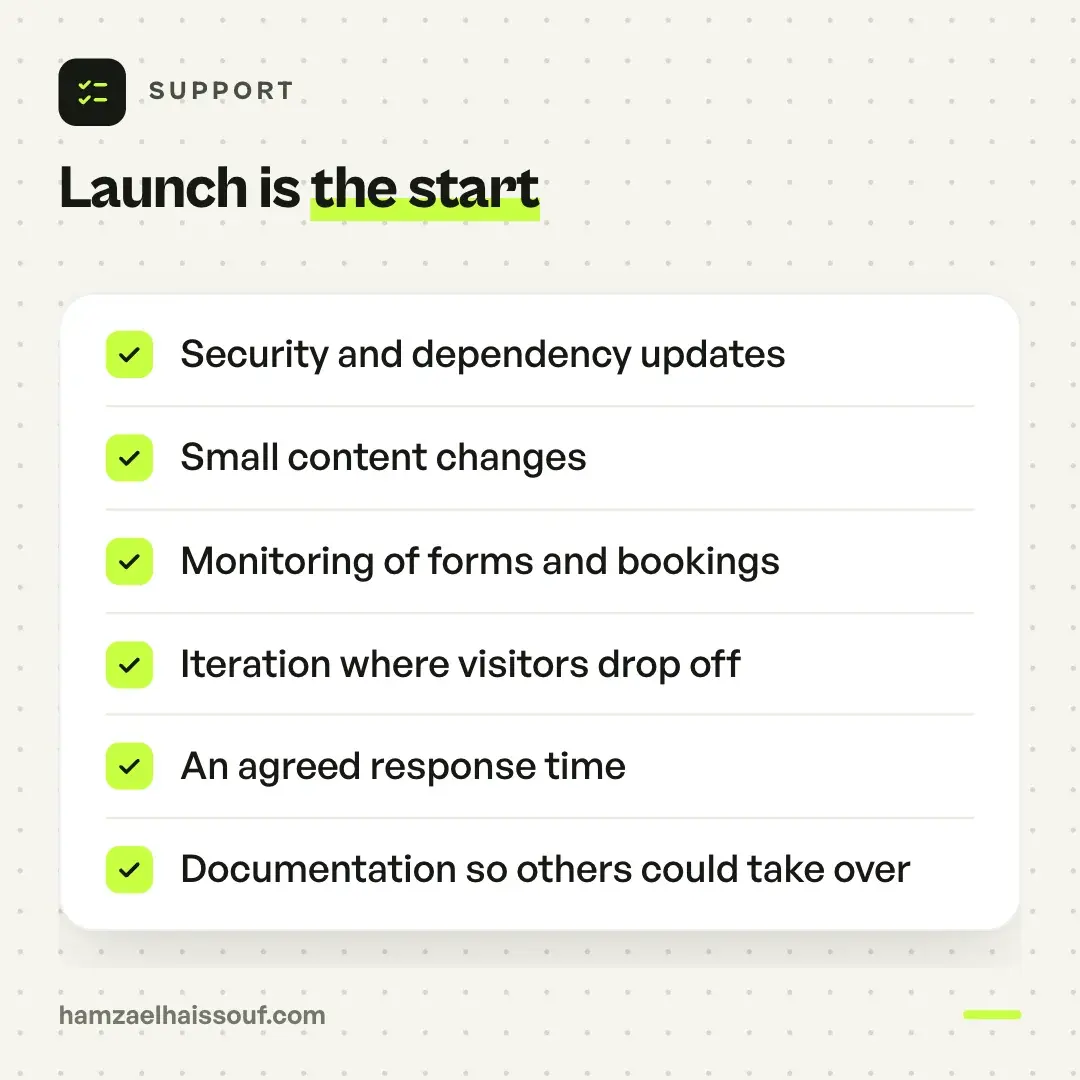
With a freelancer, agree on a simple support arrangement and a response time. With an agency, check whether support is handled by the same team that built the project. In both cases, make sure there is enough documentation that someone else could take over if needed.
When does a hybrid setup make sense?
Some businesses combine both: an agency for brand and campaigns, a freelancer for the website and automations that need to evolve quickly. Others start with a freelancer for a focused first version, then bring in an agency once marketing needs grow.
A hybrid works when roles are clear. One party owns the website code, another owns the brand guidelines, and both have access to the same analytics. It breaks when two parties believe they are responsible for the same thing.
How do you make the final decision?
Score each candidate on the points that matter for your project, for example:
- Similar shipped work you could check.
- Clarity of the written scope.
- Answers to the seven questions above.
- Ownership and handover terms.
- Support plan after launch.
- How the first conversations felt: did they ask good questions?
Pick the one that scores best on the points your project depends on, not the one with the most impressive presentation. If you need a website, WhatsApp flow or automation built directly by the person you talk to, see the freelance web developer service, or read WhatsApp AI automation for business for an example of a focused project.
From shipped work
See the case studies: Doc Samad, Amana Logistics.
Frequently asked questions
Is a freelancer riskier than an agency?
The risk is different, not necessarily higher. With a freelancer, the main risk is availability: illness, holidays or too many clients. With an agency, it is dilution: the senior people sell the project and juniors build it. Both are reduced by clear documentation, shared access to every account, and code in a repository you own.
Can a freelancer handle design, development and SEO?
Many can handle all three for a focused website or app, especially when the design follows an existing brand. For a full rebrand, a large content programme or paid campaigns at scale, a freelancer will usually bring in specialists or recommend an agency.
Who should own the domain, hosting and code?
You. Register the domain in your company's name, open hosting and third-party accounts with your email, and ask for the code in a repository you control. Your developer gets access, not ownership.
How do I compare two quotes fairly?
Ask both candidates to describe the same scope in writing: pages or features, integrations, content responsibility, languages, launch tasks and support. Differences usually come from what is included, not from the hourly rate.
What should a project kickoff include?
A written scope, the list of accounts and access needed, a schedule with review points, who validates each step on your side, and how changes outside the scope are handled.
Can I start with a freelancer and move to an agency later?
Yes, if the work is documented and the code is clean and in your repository. Ask for a short handover document at the end of every project, whoever builds it.

Hamza El Haissouf
Full-stack developer for 6 years · Morocco
I build WhatsApp assistants and websites for private clinics and logistics companies. Remote, in English and French.
Related reading